
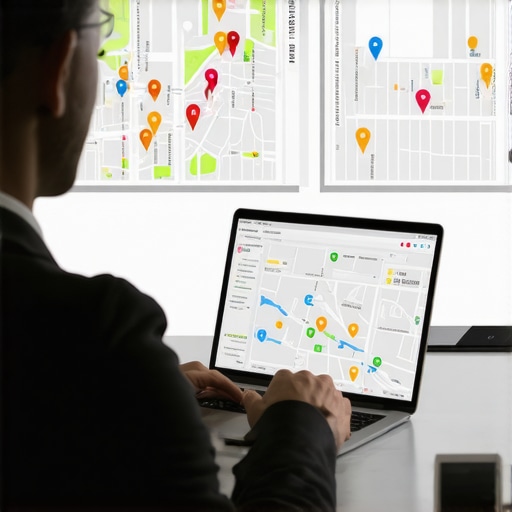
The 4 Map Tracking Tools That Actually Predict Real Store Visits
1. Introduction: The Death of the “City-Wide” Ranking
For years, I have listened to business owners brag about ranking #1 in their city. My response is always the same: “Where exactly were you standing when you checked?” In the world of google business profile seo, the concept of a city-wide ranking is not just an oversimplification – it is a lie. If you are using a traditional rank tracker that gives you a single numerical value for an entire metropolitan area, you are flying blind.
The reality of the 2026 local search landscape is defined by the “Proximity Paradox.” Google’s algorithm is hyper-sensitive to the user’s physical location. Proximity remains a top three ranking factor, often outweighing relevance and prominence if the user is searching from a specific street corner. You might rank in the top spot for “coffee shop” while standing in front of your store, but move three blocks to the north, and you might vanish from the Local Pack entirely. This is why The Real Reason Your Rank Tracker Is Lying to You About Foot Traffic is the first hurdle every local business must overcome.
To predict real store visits, we must stop looking at static lists and start looking at geogrids. A geogrid doesn’t just tell you that you rank; it tells you where you rank geographically. If your visibility drops off a cliff the moment a customer crosses a major intersection, your “ranking” is effectively useless for half your potential market. To win in 2026, you need tools that map your dominance block-by-block.
2. Why Most Rank Trackers Fail the “Store Visit” Test
The fundamental gap in traditional SEO is the distance between a search result and a physical conversion. Most local seo tools focus on the leading indicator: the rank. But as I’ve always argued, ranking is a means to an end, not the end itself. The lagging indicator – the one that actually pays your bills – is the store visit or the phone call.
Standard rank trackers often use data centers or broad IP-based location spoofing. This provides a “clean” result that doesn’t reflect the messy, GPS-driven reality of a mobile user walking down the street. When a customer searches for a service “near me,” Google isn’t looking at the city center; it’s looking at the 500-meter radius around that person’s smartphone. If your tracking software isn’t simulating these micro-locations, you are making decisions based on faulty data. It is time to Stop Chasing Rank: 3 Local Metrics That Actually Pay the Bills and start focusing on conversion-centric data. A “rank” is a vanity metric; a “visit” is a business metric.
3. Tool #1: Nightwatch, The GPS-Precise Heatmap
When it comes to high-level visualization, Nightwatch has established itself as a premier google maps rank tracker for 2026. What sets this tool apart is its ability to aggregate GPS-precise data across the Local Pack and present it in a way that correlates directly with physical movement patterns.
Key Features of Nightwatch:
- Visual Heatmap Grids: Instead of a spreadsheet, you get a literal map overlay showing your rank at specific coordinates.
- Competitor “Dead Zone” Identification: You can see exactly where a competitor’s proximity “bubble” begins to push you out of the top three.
- Multi-Location Performance: For franchises, Nightwatch allows for a bird’s-eye view of an entire region, identifying which specific branches are underperforming in their immediate vicinity.
The data point that matters here is the “Visibility Radius.” In my consultancy work, I’ve found that businesses using visual heatmaps can identify “dead zones” – areas where they should be ranking but aren’t due to minor technical errors or lack of local citations. By visualizing these gaps, you can deploy hyper-local ad spend or localized content to reclaim that territory, turning a “grey” spot on the map into a high-traffic zone.
4. Tool #2: Local Dominator, The Block-by-Block Specialist
If you want to understand the granular “why” behind your traffic fluctuations, Local Dominator is the tool for the job. This software is built specifically for the google maps ranking service industry, focusing on the hyperlocal geogrid. It moves beyond the 3×3 grid and allows for massive 13×13 or even 15×15 scans that cover every street corner in a service area.
The power of Local Dominator lies in its frequency and precision. By seeing how your rank changes from one block to the next, you can diagnose issues that are often invisible to the naked eye. For example, if you rank #1 on the west side of a highway but #9 on the east side, you’ve identified a physical barrier that Google’s algorithm perceives as a boundary. Understanding these 5 Invisible Ranking Factors That Push Your Rivals Above You is essential for anyone serious about local dominance. Local Dominator provides the evidence you need to adjust your service area settings and local landing pages to compensate for these digital “walls.”
5. Tool #3: SEO Viper Tools, The Conversion & Audit Powerhouse
For those who view local SEO as infrastructure rather than just marketing, SEO Viper Tools is the essential suite. This isn’t just a tracker; it is a full-scale google business profile optimization platform. It bridges the gap between “Where do I rank?” and “How do I fix it?”
Features to Highlight:
- Comprehensive GBP Audit Tool: Instantly identifies missing attributes, category conflicts, and photo optimization gaps.
- Lead Generation Tracking: Connects map visibility directly to phone calls and direction requests.
- Local SEO Automation: Automates the mundane tasks of posting and review responding, which are critical for maintaining rank.
Research has shown that a 400% increase in Map Pack visibility can lead to a 50% rise in actual foot traffic. SEO Viper Tools is designed to facilitate this growth by identifying the highest-impact changes you can make to your profile today. It’s not just about seeing the map; it’s about having the tools to change the colors on that map from red to green. If you are providing a gmb ranking service to clients, this is the “audit to conversion” pipeline you’ve been looking for.
6. Tool #4: KrakenTrack, The Data Scientist’s Choice
For agencies managing hundreds of locations, the manual checking of heatmaps becomes a bottleneck. KrakenTrack solves this by being the data scientist’s choice for google business profile seo. Its standout feature is the deep Google Sheets™ integration, allowing for automated scanning and custom reporting that can be white-labeled for clients.
The value here is in the “Automated Trend Analysis.” KrakenTrack doesn’t just show you today’s rank; it tracks the velocity of your ranking changes over time. If your visibility radius is shrinking, KrakenTrack alerts you before your phone stops ringing. This proactive approach prevents the common pitfall I call The Fatal Flaw in Most Google Maps Ranking Reports: looking at historical data that is already too old to act upon. KrakenTrack ensures your data is fresh, actionable, and integrated into your existing reporting stack.
7. From Tracking to Action: How to Turn Data into Visits
Having the best tools in the world won’t help you if you don’t know how to interpret the data. As I always say, Local SEO is about building a digital version of your physical storefront that is just as inviting and accessible. Once you have your geogrid data from a tool like SEO Viper, follow this checklist to rank google business profile effectively:
- Fix NAP Consistency: Ensure your Name, Address, and Phone number are identical across the web. Even a misplaced suite number can confuse the proximity algorithm.
- Optimize Categories: Your primary category is the most powerful lever you have. Use your tracking data to see if a secondary category might help you capture more “dead zones.”
- Execute Local Infrastructure: Use these 7 Direct Ways to Get 2026 Google Maps Customers Without Ads to build a profile that converts.
- Review Velocity: It’s not just about the rating; it’s about the frequency. A steady stream of new reviews tells Google you are still relevant to the local community.
By focusing on these fundamentals, you move from being a passive observer of your rankings to an active driver of your store’s foot traffic. Use the rank google business profile features in your chosen tool to measure the impact of every change you make.
8. Conclusion & Final Verdict
In 2026, ranking is no longer a “set it and forget it” metric. It is a fluid, geographical battleground. To predict real store visits, you must move away from city-wide averages and embrace the precision of geogrid tracking. Whether you choose the visual depth of Nightwatch, the granularity of Local Dominator, the automation of KrakenTrack, or the all-in-one power of SEO Viper Tools, the goal remains the same: revenue.
Don’t let your competitors own the blocks around your business. Audit your profile today using the google business profile audit tool at SEO Viper Tools and start turning those map pins into real-world customers.